Mining Pools for Home Miners (2025) – Solo vs Pool, Fees, Payouts and Latency
- December 2, 2025
- foer
If you are running a miner at home – in an apartment, basement or garage – the pool you choose has a direct impact on how often you get paid, how stable your income is and how much of your electricity bill you can realistically offset.

Most pool reviews are written for large farms. This guide is different. It is written for home miners with limited hashrate who care about:
- Frequent, reliable payouts
- Low friction and clear rules
- Minimising wasted hashrate through stale shares and bad settings
Below you will find a complete framework to choose a pool, compare solo and pool mining, and avoid the common traps that hurt small miners the most.
Quick Comparison: Solo vs Pool for Home Miners
Below is a high-level comparison table specifically from a home miner’s perspective.
| Aspect | Solo Mining | Regular Pool Mining |
|---|---|---|
| Payout pattern | Very rare, very large (if you hit a block) | Frequent, smaller, more predictable |
| Variance | Extremely high | Lower, depends on payout model |
| Suitable hashrate | Works, but odds are tiny for small rigs | Works for any hashrate |
| Main use case | Lottery-style “jackpot” mining | Offsetting power bill, steady sats |
| Emotional impact | Long dry stretches, requires strong discipline | Easier to stay motivated with regular payouts |
| Risk of never being paid | Real and significant | Very low if pool is reputable and you reach minimum |
Both paths are valid. The important thing is to consciously choose which profile you fit.
Why Pool Choice Matters Much More for Home Miners
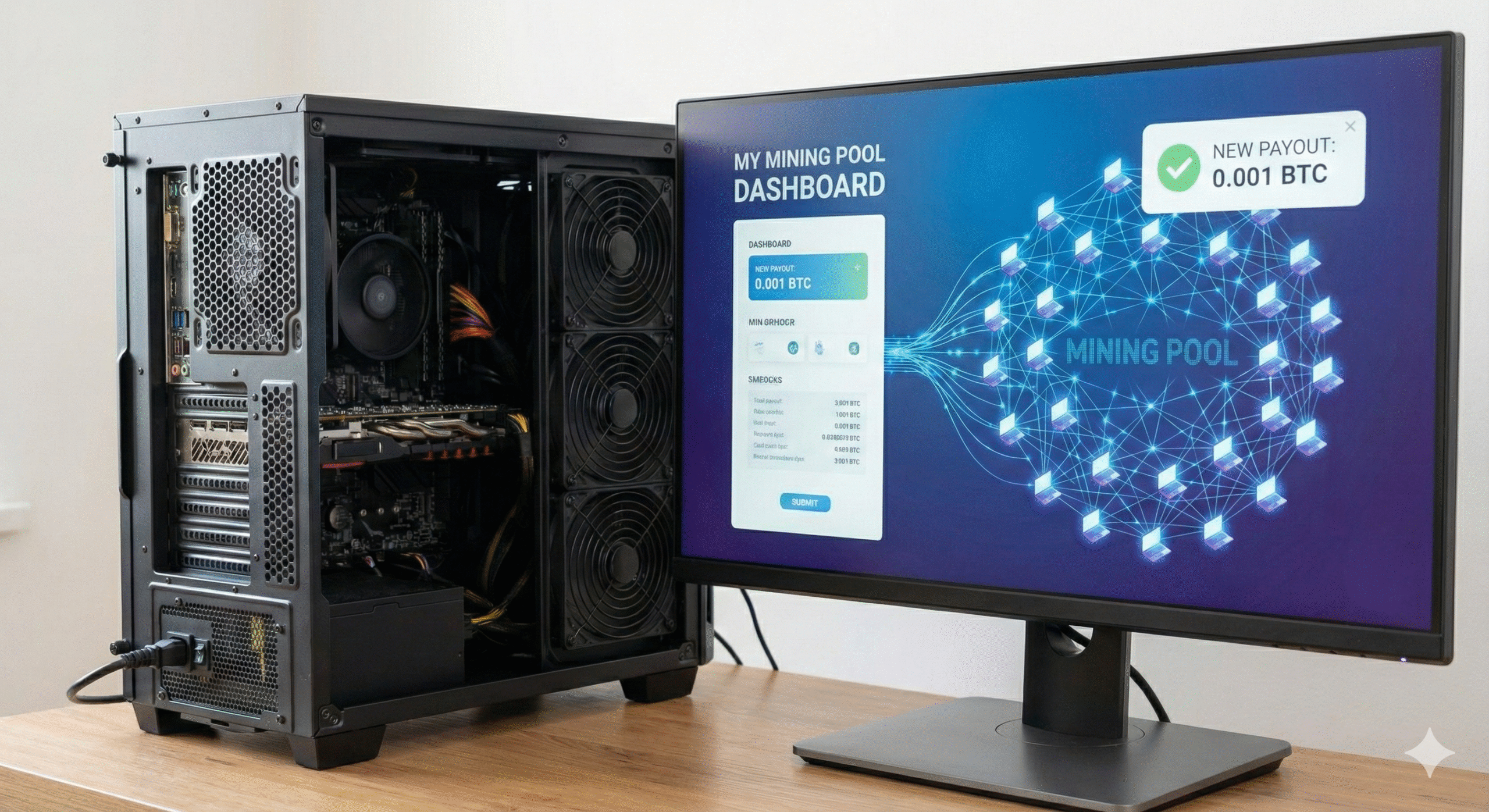
Big farms can smooth out bad luck with sheer hashrate. A home miner cannot.
With a small setup, the wrong pool can mean:
- You hit the minimum payout only once every few months
- A high minimum threshold turns small balances into permanent “dust”
- An unstable server or poor internet connection quietly destroys part of your revenue
- You overpay in fees just to get paid in a coin or model that does not fit your situation
For a home miner, the pool is not just a technical detail – it is part of your risk management and cashflow plan.
Think in simple questions:
- How often do I want to be paid?
- Am I okay with big variance, or do I want stability?
- How sensitive am I to a few euros or dollars difference on the power bill?
Your answer to these questions will decide whether solo, regular pool or a hybrid strategy makes sense.
Different Types of Home Miner (Identify Yourself First)
Before looking at individual pools or payout models, be honest about your own profile. Most people at home fit into one of these three categories.
The lottery miner
- Wants a real chance, however small, to hit a full block reward
- Treats electricity cost as the price of a lottery ticket
- Is okay with months or years of zero payout as long as the odds are understood
The steady payout miner
- Wants small, frequent payouts and predictable income
- Focuses on covering part of the power bill or stacking sats slowly
- Is not comfortable with long dry spells or high variance
The hybrid miner
- Runs on a regular pool most of the time
- Occasionally switches to solo or a high-variance setup for fun
- Tracks power cost, payouts and long-term performance reasonably closely
Keep this picture in mind as you read the rest. Your profile will tell you how to weigh each factor.
Key Factors When Choosing a Pool as a Home Miner
There are four big categories to look at:
- Fees and minimum payout thresholds
- Payout models (PPS, FPPS, PPLNS, SOLO and variants)
- Server locations, latency and connection stability
- Reputation, history and transparency
Each of these interacts with your hashrate and electricity price.
Fees and Minimum Payouts: The Hidden Killers for Small Hashrate
Most people look only at the headline fee (for example “1% pool fee”). For home miners, the minimum payout and the effective fee matter just as much.
Important points:
- A pool with slightly higher fee but low minimum payout can be better than a “cheap” pool with a high threshold
- Any amount that never reaches the payout threshold is effectively lost income
- Small hashrate plus high threshold is a bad combination
Imagine these two simplified examples for a home miner earning the equivalent of 1.50 units (dollars, euros) per day:
- Pool A: 1% fee, minimum payout 20 units
- Time to reach minimum: roughly 13–14 days
- Pool B: 2% fee, minimum payout 5 units
- Time to reach minimum: roughly 3–4 days
Even with a slightly higher fee, many home miners will prefer Pool B because:
- They get paid more often
- They see progress and can verify things are working
- Their risk of leaving trapped dust behind is lower if they ever decide to switch pools
Always estimate:
- “How many days will it realistically take me to reach the minimum payout with my hashrate and current difficulty?”
If the answer is “months”, reconsider that pool.
Understanding Payout Models (PPS, FPPS, PPLNS, SOLO)
Payout models decide how your valid shares are turned into rewards. For a home miner, this can be the difference between:
- A smooth monthly curve of income
- Roller-coaster payouts that test your patience
Here is a simplified overview:
| Model | How it pays you | Typical effect for home miners |
|---|---|---|
| PPS | Fixed amount per share; pool takes variance risk | Very stable, often higher fee |
| FPPS | Like PPS but includes transaction fees in rewards | Stable and more complete rewards |
| PPLNS | Pays based on last “N” shares before a block is found | More variance, usually lower fees |
| SOLO | Pays only if you (or your address) find a block | Extreme variance, lottery-style |
What this means in practice:
PPS (Pay Per Share)
- You get paid for each valid share, regardless of whether the pool is lucky or unlucky
- Income is stable and predictable
- Pool usually charges a higher fee because it takes on risk
FPPS (Full Pay Per Share)
- Same as PPS, but also distributes transaction fees
- Often gives better long-term value than basic PPS
- Also tends to come with slightly higher fees
PPLNS (Pay Per Last N Shares)
- Rewards depend on your contribution to the pool’s last window of shares before a block
- If the pool is lucky and you are online the whole time, payouts can be good
- If you frequently stop and start your miner or hop between pools, you may be penalised
SOLO
- You only get paid when a block is found by you or your address
- Expected time to hit a block can be many years for a small miner
- Emotionally and financially difficult unless you really treat it as a lottery
For most home miners who want steady payouts, PPS or FPPS models are easier to live with, despite slightly higher fees.
PPLNS can make sense if:
- Your miner runs 24/7 with very high uptime
- You are okay with some weeks being better and some worse
- You are disciplined enough not to jump between pools whenever luck looks bad
Latency, Stale Shares and Server Locations
Even a perfectly chosen payout model can be undermined by poor connectivity.
Latency is the time it takes for your shares to reach the pool. Problems here show up as:
- High stale share percentage
- Lower effective hashrate reported by the pool than what your miner UI shows
Things to pay attention to:
- Choose the server region closest to your physical location
- Avoid sending traffic through unnecessary VPNs or complicated routing
- If the pool offers several endpoints (for example EU, US, Asia), test them and choose the one with the most stable performance, not just the lowest ping once
Connection stability matters just as much as raw latency. A stable 90 ms connection is often better than a flaky 40–60 ms connection with packet loss.
Wi-Fi vs Ethernet for Home Mining
You can mine over Wi-Fi. Many people do. The question is not “Is Wi-Fi possible?” but “Is Wi-Fi good enough in your specific environment?”
Common Wi-Fi issues:
- Crowded channels in apartment buildings
- Interference from neighbours, microwaves, thick walls
- Routers overloaded with phones, TVs and smart devices
These problems may be invisible in day-to-day browsing but will show up in your mining stats as:
- Random spikes in stale shares
- Miner showing “Network error” events or reconnections
- Pool-side hashrate that looks lower than expected
Ethernet advantages:
- Consistent latency and low jitter
- Less interference and fewer variables
- Easier debugging (cable good or bad, port working or not)
If you are serious about home mining and can physically run a cable, Ethernet is usually the safest choice. If you must use Wi-Fi, treat optimising your network as part of your mining setup, not an afterthought.
Reputation, Age and Transparency
As a home miner, you are trusting a third party to:
- Measure your hashrate
- Record your valid shares
- Pay you fairly and on time
It is worth pausing for a basic due diligence check:
- How long has the pool been operating?
- Are fees and payout rules clearly documented?
- Does the dashboard show real-time stats, luck, stale share rate and recent blocks?
- How do other miners describe their experience?
You do not need perfection. But if you see consistent reports of missing payouts, opaque rules or sudden unexplained changes, it is safer to choose another pool, especially when your hashrate is small and margins are thin.
Algorithm and Coin Considerations for Home Miners
Your pool decision also depends on what you are actually mining. A few examples:
SHA-256 (BTC, BCH and similar)
- Network difficulty is high, so solo mining is a true long-odds lottery for small rigs
- Most home miners use regular pools for more frequent payouts
- Key points: minimum payouts, payout model, region and whether the pool supports any advanced features you care about (for example, different payout currencies)
Scrypt (LTC and DOGE)
- Many pools offer merged mining, so you earn both LTC and DOGE
- You should check how the pool handles the secondary coin (for example, pays out directly, converts automatically, or uses some internal credit)
- Minimum payouts for both coins matter when your hashrate is small
ETChash and other algorithms
- Smaller coins and networks may have fewer reliable pools
- Look carefully at reputation, minimum payouts and withdrawal options
- Some pools auto-exchange to a different coin; make sure you understand the path from your miner to your final wallet
Simple Step-by-Step Framework to Choose a Pool
To avoid getting lost in details, you can follow a simple five-step process:
- Define your profile
- Decide whether you are closer to lottery, steady or hybrid miner.
- If you strongly want predictable income, lean toward regular pools with PPS or FPPS.
- Filter by payout model and reputation
- Ignore pools that only offer models that do not fit your risk tolerance.
- Remove any pool with unclear documentation or persistent negative feedback.
- Check minimum payouts against your hashrate
- Estimate your daily earnings at current difficulty and price.
- Aim for a pool where you can reasonably hit the minimum at least once every 1–2 weeks.
- Evaluate server regions and network path
- Choose the closest region and test your latency and stale share rate.
- Prefer a stable wired connection if possible.
- Make a small-scale test and monitor
- Run your miner on the chosen pool for at least several days.
- Track: reported hashrate, stale share percentage, payout timing and any issues.
- Only then decide whether to stay long term or try a different option.
Example Home Mining Scenarios and Pool Choices
To make all of this more concrete, here are a few realistic scenarios.
Quiet apartment miner with one small device
- Power use: 300–500 W
- Environment: apartment, neighbours on the other side of the wall
- Goal: warm the room a bit and slowly stack sats
- Best fit: a reputable pool with PPS or FPPS, low minimum payout and local server region
Priorities:
- Low noise and stable network
- Payouts frequent enough to feel “real”
- Minimal tinkering once everything works
Garage or basement miner with 1–2 kW total power
- Power use: 1–2 kW, multiple devices or a mid-range unit
- Environment: garage, basement or separate room
- Goal: serious but still hobby-level mining, with partial bill coverage
Possible strategy:
- Use a stable PPS or FPPS pool as the main destination
- Experiment with a second pool or a solo setup for a small portion of time or hashrate
- Compare effective payouts and stale shares over several weeks
Priorities:
- Long-term reliability
- Manageable variance
- Tools and dashboards that make it easy to audit performance
Lottery-focused miner
- Power use: varies, but hashrate is not farm-level
- Goal: small chance at a life-changing block, fully aware of the odds
Strategy:
- Use a solo-friendly setup or pool
- Treat all payouts as pure upside and electricity as an entertainment cost
- Optionally, keep some hashrate on a regular pool to avoid complete dry spells
Priorities:
- Honest information about odds and expected time to find a block
- Clear setup instructions to avoid misconfiguration
- Emotional discipline to stick to the plan
When and How to Switch Pools Safely
It is normal to change pools over time. The key is to do it without accidentally losing payouts.
When it may be time to move:
- Fee increases without added value
- Repeated payout delays or unexplained changes to thresholds
- Persistent technical issues or poor communication
- Your own hashrate or goals change significantly
Safe switch checklist:
- Check your current unpaid balance and how close it is to the minimum payout
- If you are very close, consider waiting for a payout before switching
- Configure the new pool in your miner, double-checking worker name and payout address
- Run on the new pool for several days while monitoring both miner UI and pool dashboard
- After you are confident the new setup is stable, remove any outdated backup pools you no longer want to use
Common Mistakes Home Miners Make with Pools
Some mistakes appear again and again in home mining setups:
- Choosing a pool based only on fee percentage, ignoring payout model and thresholds
- Using a far-away server because it “sounds bigger” or is recommended for a different region
- Mining over unstable Wi-Fi without monitoring stale share percentage
- Jumping from pool to pool whenever luck looks bad, especially with PPLNS
- Ignoring small trapped balances when switching pools, which add up over time
Avoiding these mistakes does not require advanced skills. It mainly requires patience, a bit of basic math and clear expectations.
Frequently Asked Questions About Mining Pools for Home Miners
How often should a home miner expect to be paid?
This depends on your hashrate, difficulty, coin and pool settings. As a rough guideline, many home miners feel comfortable if they receive a payout at least every 1–2 weeks. If your setup would only reach the minimum threshold every few months, that pool is probably not a good match for your scale.
Is a 1% vs 2% pool fee a big deal for small miners?
Over a long period, yes, fees matter. However, for home miners, the payout model and minimum threshold often matter more. A 1% pool with a very high minimum payout may be worse for you than a 2% pool that pays you reliably every few days. Look at the full picture, not only the headline fee.
Can I mine over Wi-Fi, or do I need Ethernet?
You can mine over Wi-Fi, but you should verify that your connection is stable and that stale shares remain low. In many homes, Wi-Fi is crowded and unpredictable. If it is practical to run an Ethernet cable, that is usually the safer option, especially if you intend to mine long term.
Which payout model is best for home miners?
There is no single best model for everyone, but PPS or FPPS are usually the most comfortable for small miners who want predictable income. PPLNS can work well if your miner is online 24/7 and you are patient. SOLO is only appropriate if you consciously accept lottery-level variance.
For home miners, choosing a pool is less about chasing the “perfect” option and more about finding a good fit for your hashrate, region, risk tolerance and goals.
If you define your profile clearly, understand payout models, respect minimum thresholds and pay attention to latency and stale shares, you will already be ahead of most beginners.
From there, you can refine: test one or two reputable pools, compare data over time and slowly tune your setup. Mining rewards may be uncertain, but your decision-making does not have to be.