
Jasminer X16-Q vs iPollo V1 Mini – Which Quiet ETC Miner Is Better for Home Mining?
- December 2, 2025
- foer
The Jasminer X16-Q and the iPollo V1 Mini sit in the same broad niche: compact, relatively quiet Ethash / Etchash ASICs that you can actually run at home for Ethereum Classic (ETC) and similar coins. But they live in different weight classes:
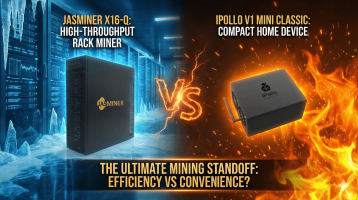
- Jasminer X16-Q is a “living-room class” miner: around 1.9–2.0 GH/s at ~620 W, with low-RPM fans and a big chassis.
- iPollo V1 Mini is a “desktop box” miner: around 300 MH/s at ~240 W for the main variant, or 130 MH/s at ~104 W for the Classic version.
This comparison will walk through specs, efficiency, noise, heat, electricity cost, and use cases so you can decide which device fits your home, your budget, and your expectations.
You can later turn phrases like “Jasminer X16-Q review”, “iPollo V1 Mini Classic guide” or “ETC home mining profitability” into internal links on your site.
Quick Spec Comparison Table
The table below focuses on the main variants home miners actually buy:
| Feature | Jasminer X16-Q | iPollo V1 Mini (300 MH/s) | iPollo V1 Mini Classic (130 MH/s) |
|---|---|---|---|
| Algorithm | EtHash / Etchash (ETC, ETHW, etc.) | EtHash (ETC, ETHF, ETHW, etc.) | EtHash (ETC-oriented) |
| Hashrate (typical) | 1.95 GH/s (1950 MH/s) | 300 MH/s ±10% | 130 MH/s |
| Power draw (typical) | ~620 W | ~240 W | ~104 W |
| Efficiency | ≈0.32 J/MH | ≈0.8 J/MH | ≈0.8 J/MH |
| Noise (manufacturer / tests) | Spec ~40 dB, measured ≈40–50 dB in reviews | ≤55 dB indoors | ~45–55 dB |
| Size | ~360 × 482 × 134 mm, ~10 kg | 179 × 143 × 90 mm, ~2.1 kg | 148 × 158 × 78 mm, ~1.0 kg |
| Memory | 8 GB | 6 GB (design), ~5.8 GB usable | 3.8 GB |
| Interface | Ethernet | Ethernet | Ethernet |
| Typical positioning | Quiet “big” home miner / heater | Desktop / shelf ETC box | Ultra-low-power mini miner |
Key point: the X16-Q delivers around 6.5× more hashrate than the 300 MH/s V1 Mini, at roughly 2.6× more power. It is both faster and more efficient, but also bigger and more expensive.
Main Takeaways
If you just want the quick answer:
- Pick Jasminer X16-Q if you want:
- Maximum hashrate in a still-quiet form factor
- Much better efficiency per MH (roughly 0.32 J/MH vs ~0.8 J/MH on V1 Mini)
- A living-room or small-office miner that can double as a space heater
- Pick iPollo V1 Mini if you want:
- Lower entry cost and smaller physical footprint
- Lower total power draw (especially the 130 MH/s Classic at ~104 W)
- A “plug-and-play” little ETC box you can place on a desk or shelf
- In pure performance and efficiency, Jasminer X16-Q dominates.
- In pure size, power draw and budget friendliness, iPollo V1 Mini wins.
Hashrate and Efficiency: Raw Mining Power
Hashrate
- Jasminer X16-Q
- Around 1.95 GH/s on ETC in real-world tests, with some reviews reporting ~2.0–2.1 GH/s in high-performance modes.
- iPollo V1 Mini (300 MH/s)
- Around 300 MH/s ±10% on Ethash / ETC. (iPollo Store)
- iPollo V1 Mini Classic (130 MH/s)
- ~130 MH/s on ETC with optimized firmware. (cryptominerbros.com)
So, on paper:
- X16-Q vs V1 Mini 300: ~1,950 / 300 ≈ 6.5× more hashrate.
- X16-Q vs V1 Mini Classic: ~1,950 / 130 ≈ 15× more hashrate.
Efficiency (J/MH)
Using typical specs:
- Jasminer X16-Q: 620 W / 1,950 MH/s ≈ 0.32 J/MH.
- V1 Mini 300: 240 W / 300 MH/s ≈ 0.8 J/MH.
- V1 Mini Classic: 104 W / 130 MH/s ≈ 0.8 J/MH.
This is the crucial insight:
- Jasminer X16-Q is roughly 2.5× more efficient per MH than either V1 Mini variant.
So if your kWh price is high and you care about long-term viability, X16-Q is objectively the better ASIC. You just have to accept the higher upfront cost and total power draw.
Noise, Heat and Home Friendliness
Noise
- Jasminer X16-Q
- Manufacturer spec lists about 40 dB noise level. (mineshop.eu)
- Independent tests report average noise in the low-40s dB range during steady ETC mining at stock settings, thanks to large low-RPM fans in a big chassis. (Minetheasic)
- iPollo V1 Mini / V1 Mini Classic
- Indoor noise spec ≤55 dB for the 300 MH/s V1 Mini. (CryptoCompare)
- Classic variant is often quoted around 45–55 dB depending on firmware and fan curve.
Practical translation:
- X16-Q tends to have a lower, softer fan tone because of the larger fans and bigger enclosure.
- V1 Mini units use smaller, higher-RPM fans, so the noise can feel sharper even if the dB number is similar.
Heat
Rough heat output (BTU/h) from power draw:
- X16-Q: ~620 W → about 2,115 BTU/h.
- V1 Mini 300: ~240 W → about 819 BTU/h.
- V1 Mini Classic: ~104 W → about 355 BTU/h.
So:
- X16-Q genuinely behaves like a small space heater in a room. In winter, that is a feature. In summer, it can be a problem.
- V1 Mini 300 gives noticeable warmth near the exhaust but not a full room heater.
- V1 Mini Classic is closer to a “warm router” level of heat.
Room / apartment scenarios
- If you are in a cold climate and you already pay for electric heating, X16-Q can replace a chunk of your heater load while mining.
- If your room is already too warm or you share electricity bills, a V1 Mini Classic is much easier to justify.
Power Cost: How Much Do They Cost to Run?
To keep this evergreen, we will use a simple kWh cost matrix, not coin-price-based profitability.
Assumptions:
- Jasminer X16-Q: 620 W, 24/7.
- V1 Mini 300: 240 W, 24/7.
- V1 Mini Classic: 104 W, 24/7.
Daily and monthly power cost (24/7)
| Tariff (€/kWh) | Miner | kWh / day | Cost / day | Approx. cost / month (30 days) |
|---|---|---|---|---|
| 0.10 | Jasminer X16-Q | 14.88 | €1.49 | ~€44.6 |
| 0.10 | V1 Mini 300 MH/s | 5.76 | €0.58 | ~€17.3 |
| 0.10 | V1 Mini Classic 130 MH/s | 2.50 | €0.25 | ~€7.5 |
| 0.20 | Jasminer X16-Q | 14.88 | €2.98 | ~€89.3 |
| 0.20 | V1 Mini 300 MH/s | 5.76 | €1.15 | ~€34.6 |
| 0.20 | V1 Mini Classic | 2.50 | €0.50 | ~€15.0 |
| 0.30 | Jasminer X16-Q | 14.88 | €4.46 | ~€133.9 |
| 0.30 | V1 Mini 300 MH/s | 5.76 | €1.73 | ~€51.9 |
| 0.30 | V1 Mini Classic | 2.50 | €0.75 | ~€22.5 |
Relative picture:
- At the same electricity price, X16-Q costs about 2.6× more to run than a 300 MH/s V1 Mini and about 6× more than a 130 MH/s Classic.
- But it also produces roughly 6.5× more hashrate than the 300 MH/s unit and ~15× more than the Classic.
If you value both sats and heat:
- X16-Q often makes sense in winter when heating is needed anyway.
- V1 Mini Classic is ideal when you want “symbolic” mining with the smallest possible footprint.
Algorithms, Coins and Future-Proofing
Both miners speak Ethash / Etchash, which are now mainly used for:
- Ethereum Classic (ETC)
- EthereumPoW (ETHW)
- EthereumFair (ETHF)
- Several smaller Ethash-family coins, plus dual-mining combinations like ETC+ZIL depending on pool and firmware support.
Key considerations:
- VRAM size matters on Ethash-family coins because the DAG size grows over time.
- Jasminer X16-Q: 8 GB → strong future-proofing for ETC and similar.
- V1 Mini 300: 6 GB design memory, ~5.8 GB usable.
- V1 Mini Classic: 3.8 GB memory, more limited for long-term DAG growth.
In an evergreen view:
- X16-Q is the safest bet if you want long-term ETC mining with margin for DAG growth and algorithm changes.
- V1 Mini 300 is fine for the medium term but may face constraints earlier.
- V1 Mini Classic is best treated as a shorter-horizon hobby device, especially if DAG sizes push close to its 3.8 GB memory.
Setup and User Experience
Jasminer X16-Q
- Designed as a complete “appliance” with integrated PSU in many bundles (always check the SKU).
- Setup flow:
- Plug in power and Ethernet
- Find IP in your router or use the vendor’s utility
- Open web GUI, set pool and wallet, apply
- Interface:
- Web dashboard with hashrate, temperature, fan speeds, and log access
- Basic but stable – ideal for “set and forget” mining
- Physical presence:
- Large, heavy case that typically lives on the floor, in a server shelf, or in a dedicated corner of a room.
iPollo V1 Mini / V1 Mini Classic
- Compact desktop form factor; many retailers bundle PSU or DC brick; verify before buying.
- Setup flow:
- Power + Ethernet
- Access web UI through local IP
- Set pool and wallet, confirm
- Interface:
- Simple web GUI; sufficient for home use, firmware updates, and basic tuning
- Physical presence:
- Sits easily on a desk, shelf, or next to a router; visually much less intimidating than a full-size ASIC.
If you care about partner comfort factor:
- A V1 Mini looks like a chunky router or small NAS.
- The X16-Q clearly looks like “a serious machine”, even if it is quiet.
Profitability and Expectations
Because coin prices, difficulty and network hashrates move constantly, exact daily revenue figures age fast. What does not change is the relative hierarchy:
- At the same electricity cost, X16-Q produces the most ETC and has the best efficiency, so if energy is not extremely expensive, it is the “serious” choice.
- V1 Mini 300 sits in the middle: modest power, modest revenue.
- V1 Mini Classic is the lowest-power, lowest-revenue option.
The right mindset for all three:
- Treat them as home-friendly miners and learning tools, not industrial ROI engines.
- Use them to:
- Get real-world exposure to ETC and Ethash mining
- Test pools, firmware, and monitoring stacks
- Combine mining with heating, where that makes sense
If you want more hardcore ROI, you usually scale to bigger, noisier miners in a dedicated space – not these “apartment class” boxes.
Use Cases and Buyer Profiles
When the Jasminer X16-Q Makes More Sense
Choose the X16-Q if most of these apply:
- Your electricity rate is not extreme, and you want maximum hashrate per watt on ETC.
- You like the idea of a space-heater miner that actually warms a small room.
- You prefer a long-term, somewhat future-proof Ethash/Etchash ASIC with 8 GB VRAM.
- You have a dedicated corner, office or mining closet for a larger, heavier unit.
- You want “one main ETC box” instead of multiple small devices.
Typical scenarios:
- Dedicated office or mining room where the miner runs as background heat.
- Enthusiast who already tried small boxes and wants a serious but still quiet upgrade.
- Long-term ETC believer who wants efficiency and VRAM headroom.
When the iPollo V1 Mini (300 MH/s) Is the Better Fit
Choose the V1 Mini 300 if:
- You want a compact box that can sit on a desk or shelf without looking intimidating.
- Your circuits or shared electricity bill can tolerate ~240 W, but 600+ W would be too much.
- You want a more budget-friendly entry into ASIC ETC mining.
- Noise in the 50 dB range is acceptable in a working room.
Typical scenarios:
- First ASIC for someone moving from GPU mining to dedicated ETC hardware.
- Multi-device setups where you combine several small boxes across rooms.
- Users who prefer to limit exposure to a single ASIC vendor / model.
When the iPollo V1 Mini Classic (130 MH/s) Is the Right Choice
The Classic variant makes sense if:
- You want the lowest possible constant power draw that still mines real ETC (around 100 W).
- You live in an apartment where any significant heat or noise is an issue.
- You treat mining as a long-term, very low-impact hobby and learning project.
- You are comfortable with the limited VRAM horizon and just want to experiment.
Typical scenarios:
- Shared apartments, dorms, and scenarios with very strict power / noise expectations.
- A single low-power miner near a router that doubles as a “live ETC tutorial”.
Running Them Together
For many home-mining enthusiasts, the realistic path is not X16-Q or V1 Mini, but X16-Q plus at least one V1 Mini:
- X16-Q → main heater-miner and ETC workhorse.
- V1 Mini Classic → ultra-low-power box near your networking gear, for testing pools and firmware.
- V1 Mini 300 → mid-tier extra unit in another room.
This combination gives you:
- Vendor diversification (Jasminer + iPollo)
- Power-level diversification (100 W / 240 W / 620 W)
- Flexibility to adapt to electricity prices and seasons
Decision Cheat-Sheet
If you only remember one section from this page, make it this one:
- Choose Jasminer X16-Q if:
- You want serious ETC hashrate at home.
- Efficiency per watt matters and your tariff is medium to high.
- You can use or tolerate the extra heat.
- You see this as a multi-year ETC miner, not a short-term experiment.
- Choose iPollo V1 Mini (300 MH/s) if:
- You want a compact, mid-power ETC box.
- You prefer smaller risk and smaller power draw.
- You are upgrading from GPUs and want a gentle ASIC learning curve.
- Choose iPollo V1 Mini Classic (130 MH/s) if:
- You must stay around 100 W but still want to mine.
- You see mining as a slow, educational hobby.
- You live in a small or shared space and want minimum heat and noise.
FAQ's
Is the Jasminer X16-Q more profitable than the iPollo V1 Mini?
At the same electricity price, yes: it has much higher hashrate and better efficiency per MH, so it earns more ETC per kWh. But it also costs more to buy and more to run. Treat profitability in relative terms and always recalculate with current ETC price and difficulty.
Which one is quieter in real life?
X16-Q usually feels quieter or at least less annoying because it uses bigger, slower fans in a larger chassis. V1 Mini devices can hit similar or slightly higher dB, but with a higher-pitched tone.
Is 8 GB VRAM on the Jasminer X16-Q overkill?
Not really. On Ethash/Etchash, DAG size grows over time. 8 GB gives you comfortable headroom for the long term, especially if you plan to mine ETC for several years. In comparison, 3.8 GB on the V1 Mini Classic is more constrained.
Can I run any of these in a bedroom?
- V1 Mini Classic is the safest bet for a bedroom, thanks to ~104 W power and moderate noise.
- V1 Mini 300 can be fine for some people, too, if placed further from the bed.
- X16-Q is usually better in a separate room or office – it is quiet for an ASIC, but still a 620 W machine.
Are these good for solo-mining “lottery” strategies?
Their hashrate is too small to make solo-mining on big chains anything more than a lottery ticket. For most users, it is more rational to mine on pools and treat these devices as home-friendly ETC miners plus heating supplements, rather than solo-mining engines.