Mini-DOGE II vs Antminer L7 for Home Mining: Quiet Desktop Box vs Industrial Scrypt Rig
- December 2, 2025
- foer
Mini-DOGE II and Antminer L7 technically do the same job: they mine Scrypt coins such as Litecoin and Dogecoin, often in merged-mining mode.
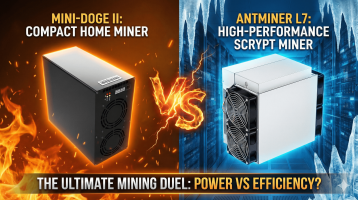
In practice, they live in completely different worlds:
- Mini-DOGE II is a compact, quiet, low-power “home miner” you can run in a normal apartment.
- Antminer L7 is an industrial-class Scrypt machine designed for mining farms, not living rooms.
This comparison focuses specifically on one question:
If you are a home miner, which one actually makes sense to run in a real house or apartment?
Quick Spec Comparison Table
(Approximate typical values; exact figures vary slightly by batch and firmware.)
| Feature | Mini-DOGE II (Performance Mode) | Mini-DOGE II (Low-Power Mode) | Antminer L7 (typical model) |
|---|---|---|---|
| Algorithm | Scrypt (LTC, DOGE, etc.) | Scrypt | Scrypt (LTC, DOGE, etc.) |
| Hashrate | ~420 MH/s | ~335 MH/s | ~9 000–9 500 MH/s |
| Power draw | ~400 W | ~260 W | ~3 200–3 300 W |
| Efficiency (J/MH) | ~0.95 J/MH | ~0.78 J/MH | ~0.35–0.37 J/MH |
| Noise | ~35 dB | ~35 dB | ~70–80 dB |
| Form factor | Small desktop box | Small desktop box | Full-size industrial unit |
| Approx. weight | ~2–3 kg | ~2–3 kg | ~14–15 kg |
| Typical placement | Desk / shelf / TV stand | Desk / shelf / TV stand | Dedicated room / garage / shed |
The picture is clear:
- Antminer L7 is roughly 20–23 times faster than Mini-DOGE II.
- It is also about 8 times more power-hungry and dramatically louder.
Key Takeaways (Quick Decision)
- Mini-DOGE II is the realistic choice for almost all home users:
- Around 420 MH/s at ~400 W (or ~335 MH/s at ~260 W in low-power mode).
- Noise levels in the mid-30 dB range, similar to a quiet office.
- Power draw in the same ballpark as a gaming PC.
- Antminer L7 is a farm-grade miner:
- Around 9 000+ MH/s at roughly 3 200 W (exact numbers depend on model).
- Noise around 70–80 dB, similar to a vacuum cleaner or hair dryer.
- Continuous heat output comparable to a powerful electric space heater.
If you live in a normal apartment with neighbors, shared walls, and standard wiring, Mini-DOGE II is almost always the only realistic option. L7 only becomes viable at home if you have:
- A separate room, garage, or shed.
- Strong electrical infrastructure.
- Serious noise and heat management.
Hashrate and Efficiency (J/MH)
From an engineering perspective you look at two things:
- How much hashrate do you get?
- How much energy do you spend per megahash (J/MH)?
Mini-DOGE II
- Performance mode: about 420 MH/s at ~400 W
- Efficiency ≈ 400 W / 420 MH/s ≈ 0.95 J/MH
- Low-power mode: about 335 MH/s at ~260 W
- Efficiency ≈ 260 W / 335 MH/s ≈ 0.78 J/MH
Low-power mode reduces hashrate but improves efficiency and makes the device easier to justify as a small “always-on” box.
Antminer L7
- Typical variant: around 9 000–9 500 MH/s at roughly 3 200+ W
- Efficiency ≈ 3 200 W / 9 000 MH/s ≈ 0.36 J/MH
On pure efficiency, L7 is the clear winner:
- Around 2–2.5× better J/MH than Mini-DOGE II.
However, home miners do not live in a data sheet. You have to combine efficiency with absolute power draw, noise, and practical constraints. That is where Mini-DOGE II becomes attractive despite being “less efficient on paper”.
Noise and Heat: Can You Live with It?
Noise
Mini-DOGE II:
- Around 35 dB in normal operation.
- This is similar to:
- A quiet desktop PC with a single 120 mm fan at low RPM.
- A small network router or NAS in an otherwise quiet room.
In a living room or office, you will notice the fan if you sit close to it, but it does not dominate the room. In low-power mode it is even easier to ignore.
Antminer L7:
- Typical noise is 70–80 dB.
- That level is closer to:
- A vacuum cleaner.
- A hair dryer.
- A loud server rack.
At this noise level:
- You cannot realistically share the same room for normal daily activities.
- Even with the door closed, you often hear the unit from neighboring rooms.
- Running it at night in a normal apartment is likely to disturb people in the same building.
Heat
Heat output is directly tied to power draw:
- Every watt of power becomes heat.
Mini-DOGE II:
- 400 W → a modest, continuous heat source.
- You will feel a warm airflow near the exhaust.
- Over time it will slightly warm up a small room, but it does not behave like a full space heater.
Antminer L7:
- 3 200+ W → a serious heat source.
- This is in the same league as a powerful electric heater.
- In a small room, the temperature can rise very quickly if you do not exhaust the hot air.
In a home context:
- Mini-DOGE II adds a small, pleasant amount of heat in cooler months.
- Antminer L7 absolutely requires a plan for hot air:
- Ducting out of a window or wall.
- A dedicated, ventilated space.
Electricity Cost Comparison
Assume both devices run 24/7.
Mini-DOGE II (performance mode)
- Power: 400 W → 0.4 kW
- Daily energy: 0.4 kW × 24 h = 9.6 kWh per day
Antminer L7
- Power: 3 200 W → 3.2 kW
- Daily energy: 3.2 kW × 24 h = 76.8 kWh per day
Now combine this with typical electricity prices:
| Tariff (€/kWh) | Device | kWh / day | Cost / day | Approx. cost / month (30 days) |
|---|---|---|---|---|
| 0.10 | Mini-DOGE II | 9.6 | €0.96 | ~€28.80 |
| 0.10 | Antminer L7 | 76.8 | €7.68 | ~€230.40 |
| 0.20 | Mini-DOGE II | 9.6 | €1.92 | ~€57.60 |
| 0.20 | Antminer L7 | 76.8 | €15.36 | ~€460.80 |
| 0.30 | Mini-DOGE II | 9.6 | €2.88 | ~€86.40 |
| 0.30 | Antminer L7 | 76.8 | €23.04 | ~€691.20 |
Key insights:
- At the same tariff, Antminer L7 costs exactly 8 times more to run than Mini-DOGE II.
- For many home users, paying a few dozen euros per month for a “fun” miner is acceptable, but paying hundreds per month is not.
- The higher your electricity price, the more attractive Mini-DOGE II becomes relative to L7.
This table says nothing about revenue from LTC/DOGE; it only shows how hard each device hits your power bill. For profitability, you must recalculate with current coin price and difficulty.
Home Setup and User Experience
Mini-DOGE II
- Runs from a normal wall socket (100–240 V).
- Small and light; you can place it:
- Beside your router.
- On a bookshelf.
- On your desk or TV stand.
- Setup is straightforward:
- Connect power and Ethernet.
- Find the IP address on your router.
- Log into the web interface, set your pool and wallet, and start mining.
Overall, it behaves like a slightly warm, slightly noisy consumer device. It does not transform the room around it.
Antminer L7
- Requires strong electrical infrastructure:
- 200–240 V.
- A circuit that can safely handle continuous 3 kW+ load.
- Heavy and bulky; typically lives:
- On the floor in a dedicated room.
- In a garage, basement, or shed.
- In a sound-dampened enclosure.
- Setup is conceptually similar (power, Ethernet, web interface), but the physical part is much more demanding:
- You must consider:
- Heat exhaust.
- Noise isolation.
- Airflow to avoid overheating.
- You must consider:
In a typical apartment, these requirements are extremely difficult to meet without disturbing other people or overloading circuits.
Profitability Mindset: Hobby Box vs Farm Rig
Because network difficulty and LTC/DOGE price move constantly, you should treat any static profitability number as temporary.
What does not change:
- At the same electricity price:
- Antminer L7 earns significantly more LTC and DOGE.
- Antminer L7 is more efficient per megahash.
However:
- L7 carries much higher operational risk at home:
- Large, constant power draw.
- Huge heat output.
- Very high noise.
Mini-DOGE II, by contrast:
- Has lower revenue but also:
- Lower power cost.
- Much lower noise.
- Much easier integration into a normal home.
You can think of the two devices as representing different philosophies:
- Mini-DOGE II:
- Long-term, low-impact Scrypt mining.
- “I want to learn, experiment, and slowly accumulate coins without destroying my lifestyle.”
- Antminer L7:
- Aggressive LTC/DOGE mining.
- “I treat this like a small business and I have space and infrastructure like a small data center.”
Which Miner Fits Which Type of User?
When Mini-DOGE II Makes More Sense
Mini-DOGE II is the right choice if you recognize yourself in most of the points below:
- You live in an apartment or shared house.
- You care about noise and want something that can run in a living room or office.
- Your electricity price is medium or high, and you want to keep the monthly cost manageable.
- You see mining primarily as:
- A learning experience.
- A hobby.
- A long-term “set and forget” approach to stacking LTC/DOGE.
- You prefer a clean, small form factor that does not dominate the room.
In this scenario, Mini-DOGE II behaves like a “smart heater plus miner” at a modest scale.
When Antminer L7 Might Be Justified
Antminer L7 makes sense only if you can honestly say yes to items like:
- You have a dedicated mining room, garage, basement, or shed.
- You can install or already have:
- Adequate ventilation and ducting.
- Sufficient electrical capacity.
- Some form of sound insulation if there are neighbors nearby.
- Your electricity tariff is relatively low, or you can use the heat in place of other electric heating.
- Your goal is to run a semi-professional or small-farm-style operation, not just a hobby box.
- You are comfortable investing in additional infrastructure (fans, ducts, sound boxes, monitoring).
Here the L7 is no longer a “home gadget”; it is the core of a small-scale Scrypt mining business that happens to be located at a residential property.
Decision Matrix for Home Miners
Use this simple matrix as a final filter.
Choose Mini-DOGE II if:
- You need something:
- Quiet enough to share a room with.
- Small enough to sit on a shelf.
- Cheap enough to run without stressing over the power bill.
- You prefer low-to-moderate risk, and you accept lower hashrate as the trade-off.
Choose Antminer L7 if:
- You have:
- A separate space where noise and heat are not a problem.
- Electrical capacity for a continuous 3 kW+ load.
- You are aiming for serious Scrypt hashrate and you treat mining as an investment or business, not just a hobby.
For the vast majority of true “home miners”, Mini-DOGE II is the practical winner. Antminer L7 belongs to a different category: powerful, efficient, and profitable in the right environ
FAQ's
Is Antminer L7 ever a good idea in an apartment?
In almost all cases, no. The noise and heat are simply too extreme for a normal apartment. Even if you could solve the electrical side, neighbors and people in your own home are very likely to complain. Antminer L7 is better suited to detached houses, garages, or non-residential spaces.
Is Mini-DOGE II really quiet enough for a bedroom?
For many people, yes, especially in low-power mode, but it depends on your sensitivity to constant fan noise. It is closer to a quiet PC than to a vacuum cleaner. If you are a light sleeper, you might prefer to place it in a hallway or office instead of the bedroom itself.
Which one is safer for my electrical installation?
Mini-DOGE II is much safer in the sense that it only draws about 400 W, similar to a strong desktop PC. Antminer L7 draws over 3 kW continuously, which is a heavy load for typical residential circuits, especially older buildings. For L7 you should think in terms of dedicated circuits, proper breakers, and possibly professional electrical inspection.
Which one is better long-term?
In pure mining terms, Antminer L7 has the stronger long-term profile because of its efficiency and hashrate. In real-world home mining terms, Mini-DOGE II is often more sustainable long-term because you are less likely to turn it off due to noise, heat, or electricity bills. The best miner is the one you can actually keep running.